



The request came in the way these things usually do. Would you read a chapter and tell us what you think of it, honestly, and if what you say is useful we would like to print it.
The book is The AI Anthology, a collection of twenty-one contributors writing on what artificial intelligence is actually doing to healthcare, leadership, ethics, business and education. Not the forecast version. The version where somebody has to make it work inside an organisation with existing staff, existing systems and existing habits.
The chapter was by Dr. Lia Patricia Gallo-Urrego. We had already built the brand, the site and the platform for EquiVox, the company she founded, so I came to the chapter knowing the argument reasonably well. That turned out to make the reading harder rather than easier. It is one thing to build something for a thesis you find convincing. It is another to read the thesis stated plainly and find it describes failures you have watched happen.

What the chapter is about
Most AI conversations in healthcare stop at the model. Accuracy, sensitivity, specificity, how it performed against the retrospective dataset, how the pilot went. All necessary. All measurable. All the part everybody is comfortable discussing.
The chapter is about what happens after that. A system passes validation, clears procurement, gets deployed, and then does nothing. Not because it is wrong. Because nobody trusts it. Because nobody explained it to the patient. Because nobody established whose job it is to act when the alert fires at 2am.
Gallo-Urrego frames this as three kinds of alignment that have to hold at once. Cognitive, whether the people using it understand what it is telling them. Interpretive, whether the output means the same thing to the clinician, the patient and the record. Structural, whether the organisation around it has actually assigned responsibility for acting on what it says.
Any one of those failing is enough to render a technically excellent system inert. All three fail quietly. None of them show up in the accuracy metric.

Why it landed
A reasonable amount of our work sits at the point where a good idea meets an organisation that has to absorb it. Bringing AI products to market means watching this pattern repeatedly, in health and well outside it.
The demo is excellent. The pitch deck is excellent. Six months later the thing is running and nobody is using it, and the post-mortem blames adoption, or training, or change management, which are all names for the same unexamined gap. The system was never wrong. It was never integrated into how decisions actually get made.
What the chapter gave me was vocabulary. I had watched cognitive, interpretive and structural failures happen without having those three words to separate them, which meant every instance looked like the same undifferentiated problem called "it did not stick." Naming the three makes them addressable. You can design against a named failure. You cannot design against a vague one.
The review
This is what ran, on page 516:
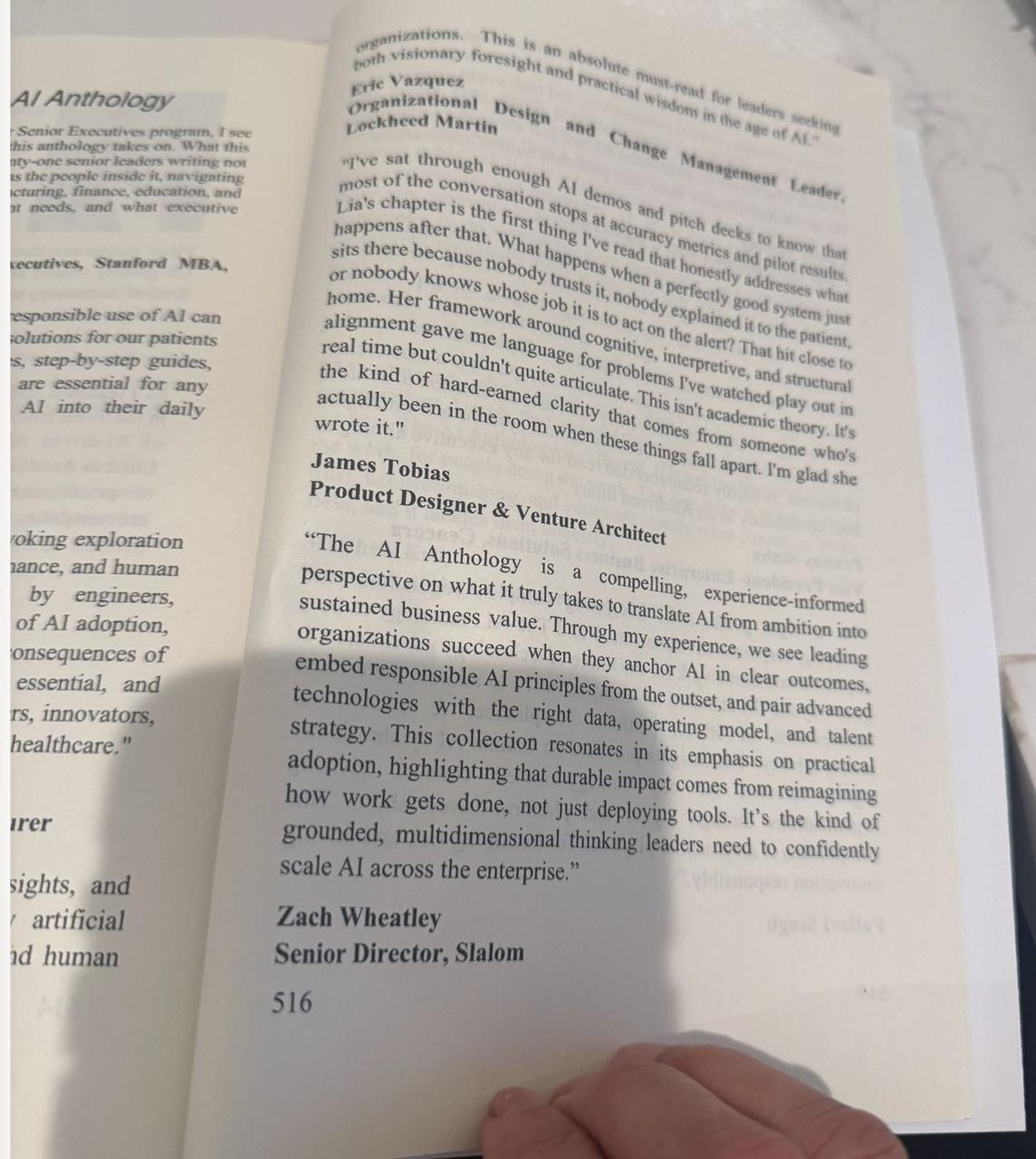
I’ve sat through enough AI demos and pitch decks to know that most of the conversation stops at accuracy metrics and pilot results. Lia’s chapter is the first thing I’ve read that honestly addresses what happens after that. What happens when a perfectly good system just sits there because nobody trusts it, nobody explained it to the patient, or nobody knows whose job it is to act on the alert? That hit close to home. Her framework around cognitive, interpretive, and structural alignment gave me language for problems I’ve watched play out in real time but couldn’t quite articulate. This isn’t academic theory. It’s the kind of hard-earned clarity that comes from someone who’s actually been in the room when these things fall apart. I’m glad she wrote it.
James Tobias
Product Designer & Venture Architect
A note on the honest version
Book endorsements are usually a genre with its own conventions, and the conventions are not truth-seeking. Compelling. Timely. Essential reading. Words that could be applied to almost anything and therefore say almost nothing.
The brief here was explicitly the opposite, which is the only reason it was worth writing. The useful thing to say about a chapter is not that it is important. It is what specifically changed after reading it. In this case, three words that separated one large vague problem into three smaller solvable ones.
That is a real thing a piece of writing can do, and it is rarer than the endorsement page of most books would suggest.
Find the book